Benefit
- Capable of providing energy modulation that is spatially variant across a field or arc.
- Reduced number of energy layers and redundant beam scanning resulting in more efficient treatment deliveries.
- 3D printed materials and design permit the device to be patient-specific, placed in close proximity to the patient surface, and minimize secondary neutron production.
- Compact design and compatible with state-of-art PBS collimators.
Technology Description
Combining pencil beam scanning (PBS) with a rotational arc-style delivery has been proposed to hold a large synergistic potential to create both more tumor-conformal and robust treatment plans. However, partitioning discrete energies across one or more arcs is a difficult optimization problem. Even with sophisticated energy-switching algorithms, the total delivery time can be significant due to the numerous energy changes required to treat the target during a rotational delivery. While algorithmic approaches have been proposed to prioritize faster energy switches, the fundamental problem of numerous energy changes persists resulting in prohibitively prolonged treatment times.
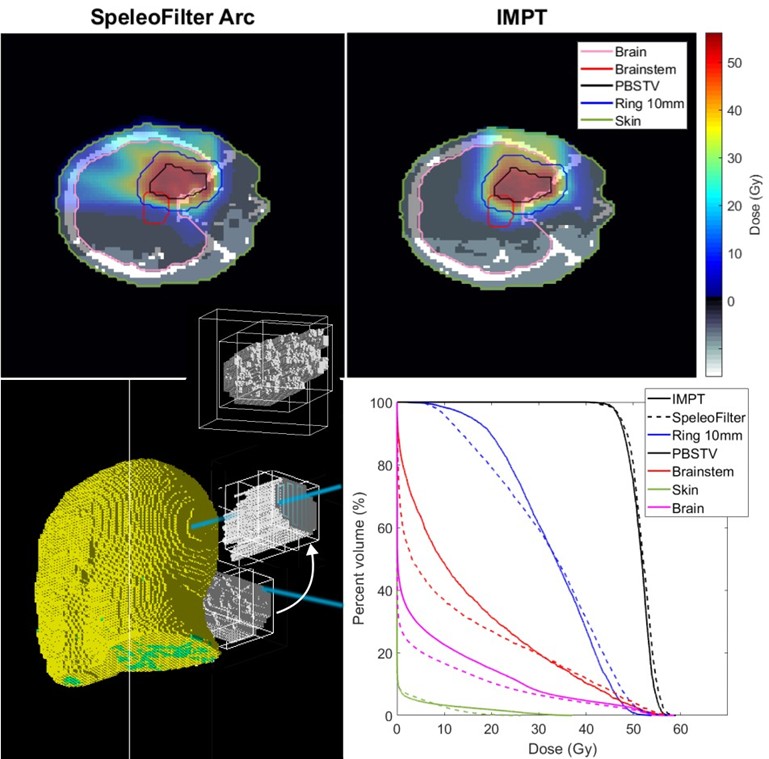
Researchers at the University of Iowa have invented a novel beam filtration apparatus called a speleofilter, that significantly reduces the number of energy changes required to treat a target. This device creates a per-spot spread-out Bragg peak dose distribution based on the internal anatomy of the intended subject, the range of delivered beam angles, and the shape of the filter.
The developed device is not restricted to a specific beam angle but rather enables an expedient delivery of PBS treatments across one or more rotational arcs by modifying the delivered beam into a spectrum of different proton energies around the patient. As such, the shape of the filter is optimized in parallel with the beam weights to achieve the desired dosimetric goals. Moreover, the filter does not rely on supplementary range compensators or other devices to modify the beam energy and is capable of a non-uniform delivery.
UIRF Case No. 2023-015
Stage of Development
Experimental testing of prototype filters.
IP Status: Patent Pending
Lead Researcher(s)
- Blake Smith, Department of Radiation Oncology